
Shows Like Murder, She Wrote
An unassuming mystery writer turned sleuth uses her professional insight to help solve real-life homicide cases.
Ranked by shared creators, cast, themes, genre, and network — not just generic recommendations.
Columbo
Created by Levinson & Link — exact same creative team; classic CBS whodunit procedural, same era and audience.

Ellery Queen
Created by Levinson & Link; writer-detective protagonist who solves murders — structurally identical to MSW.

Mannix
Created by Levinson & Link; same production DNA and CBS procedural pedigree.
Castle
Mystery novelist consults on real homicide cases — the closest modern structural twin to Murder, She Wrote.

Harry Wild
Retired older woman (Jane Seymour) turns amateur investigator; cozy tone and demographic match are near-identical.

The Mentalist
Civilian criminal consultant with exceptional observational skills solves murders alongside police — strong keyword overlap.
Jonathan Creek
Civilian puzzle-solver (magician) unravels seemingly impossible murders; cozy British mystery tone matches MSW.
Miss Fisher's Murder Mysteries
Witty female amateur sleuth solves murders with flair; cozy mystery tone, strong female lead — direct MSW peer.
Perry Mason
Same CBS golden-age mystery pedigree; civilian protagonist (lawyer) routinely solves crimes the police cannot.
Father Brown
Amateur detective (priest) solves village murders; cozy British mystery format and non-cop protagonist mirror MSW.
Midsomer Murders
Cozy British village-murder procedural; same genteel whodunit atmosphere and loyal audience demographic as MSW.
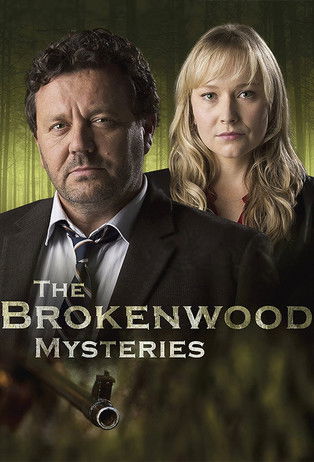
The Brokenwood Mysteries
Small-town detective in a quiet community where murder lurks; warmly comforting tone mirrors MSW's Cabot Cove formula.
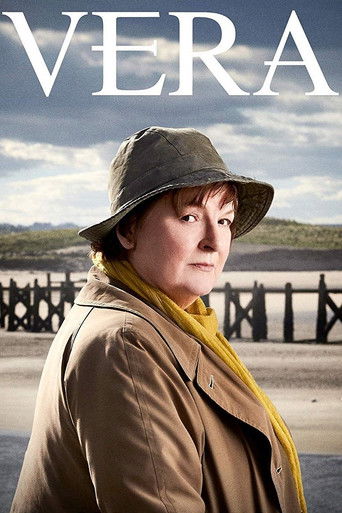
Vera
Older, unconventional female detective; same cozy-crime audience; British mystery procedural with strong character focus.
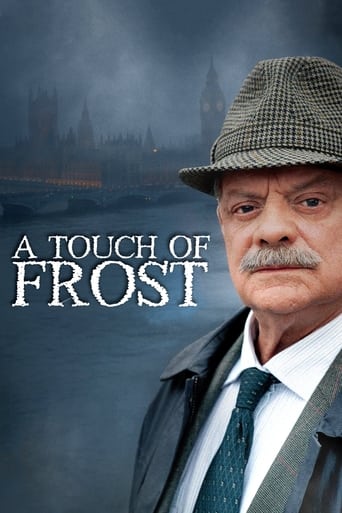
A Touch of Frost
Unorthodox British detective with warm wit; cozy crime procedural tone and era appeal overlap closely with MSW.
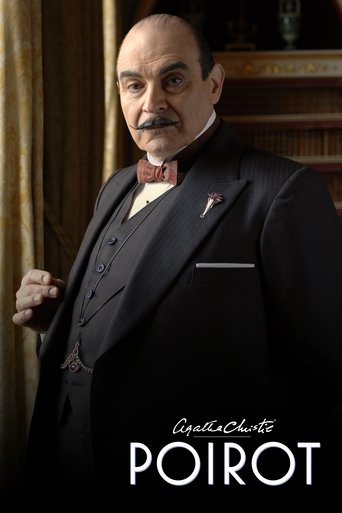
Agatha Christie's Poirot
Genteel civilian amateur sleuth solving murders in a cozy period setting — the British equivalent of MSW's formula.
Inspector George Gently
Old-school detective with strong moral compass in a period setting; cozy British mystery audience alignment.
Sherlock Holmes
Classic civilian detective solving impossible cases; same 1984 premiere year and cozy cerebral mystery appeal.
Barnaby Jones
Older private detective on CBS; same network legacy and soft-boiled mystery tone, though less amateur-sleuth framing.

Rizzoli & Isles
Female-led crime procedural with warm character chemistry; shares MSW's broad demographic but is fully police-based.
How Good Is Murder, She Wrote?
Ratings across IMDb and TMDB, plus our verdict.
Where to Watch Murder, She Wrote
Streaming, rental, and purchase options across 40+ countries.
United States
USStream
1 Philo
PhiloBuy
5 Amazon Video
 Apple TV Store
 Fandango At Home
 GRUV
GRUV Amazon DVD / Blu-ray
Available in 20 countries
Frequently asked about Murder, She Wrote
Common questions people search for, with answers written by us at MoviesPack.
How does Jessica Fletcher consistently find herself at the scene of murders?
Jessica is a retired English teacher turned bestselling mystery novelist living in the small town of Cabot Cove, Maine, whose reputation as an amateur sleuth follows her wherever she travels. The show presents this as a blend of bad luck and her natural instinct for observation — she notices details others overlook, and people around her (friends, family, fans of her books) inevitably draw her into their lives at the worst moments. Over twelve seasons the sheer frequency of deaths around her became a running joke among fans, who nicknamed Cabot Cove the 'murder capital of the world.'
What is Jessica Fletcher's method for solving murders, and how does it differ from the police?
Jessica solves cases through careful observation of behavioral inconsistencies, a sharp memory for seemingly trivial details, and an ability to empathize with suspects to draw out confessions or slips of the tongue. Unlike the police — who typically focus on obvious motives and physical evidence — Jessica approaches each crime as a narrative puzzle, asking whose story doesn't add up rather than simply who had opportunity. Her background as a mystery writer gives her an instinct for planted clues and misdirection, allowing her to see through red herrings that mislead official investigators.
Does Jessica Fletcher ever fail to solve a case, or does she ever wrongly suspect an innocent person?
Jessica rarely fails outright, but the show does portray her occasionally pursuing the wrong suspect before correcting course — a narrative device that raises the moral stakes of her amateur meddling. Several episodes explore the tension between her certainty and the real harm a false accusation can cause, particularly when the accused is someone she cares about. Her willingness to acknowledge error and redirect her investigation is presented as a defining ethical trait that separates her from more reckless sleuths.
What is the significance of Cabot Cove, and why does Jessica keep returning there despite the constant danger?
Cabot Cove is framed as Jessica's anchor — a tight-knit coastal community where she is known, trusted, and rooted after the death of her husband Frank. It represents normalcy and belonging that her celebrity as a novelist and her crime-solving reputation constantly threaten to upend. The town's improbably high murder rate is never addressed in-universe; Cabot Cove functions narratively as a mythologized 'home' that is never truly safe, reflecting a recurring theme that evil lurks even in the most idyllic communities.
How does the show handle the ambiguity of guilt — are the killers always who they appear to be?
Murder, She Wrote consistently structures its mysteries so that the most obvious suspect is rarely the true killer, using misdirection and layered backstories to subvert first impressions. Many episodes reveal that victims were themselves morally compromised — blackmailers, abusers, or fraudsters — complicating the audience's sympathy and blurring the line between justice and murder. This moral complexity was central to the show's appeal: guilt is seldom simple, and Jessica's role is less about punishment than about restoring the truth, however uncomfortable it turns out to be.
Recent Updates
New Trailer: Murder, She Wrote