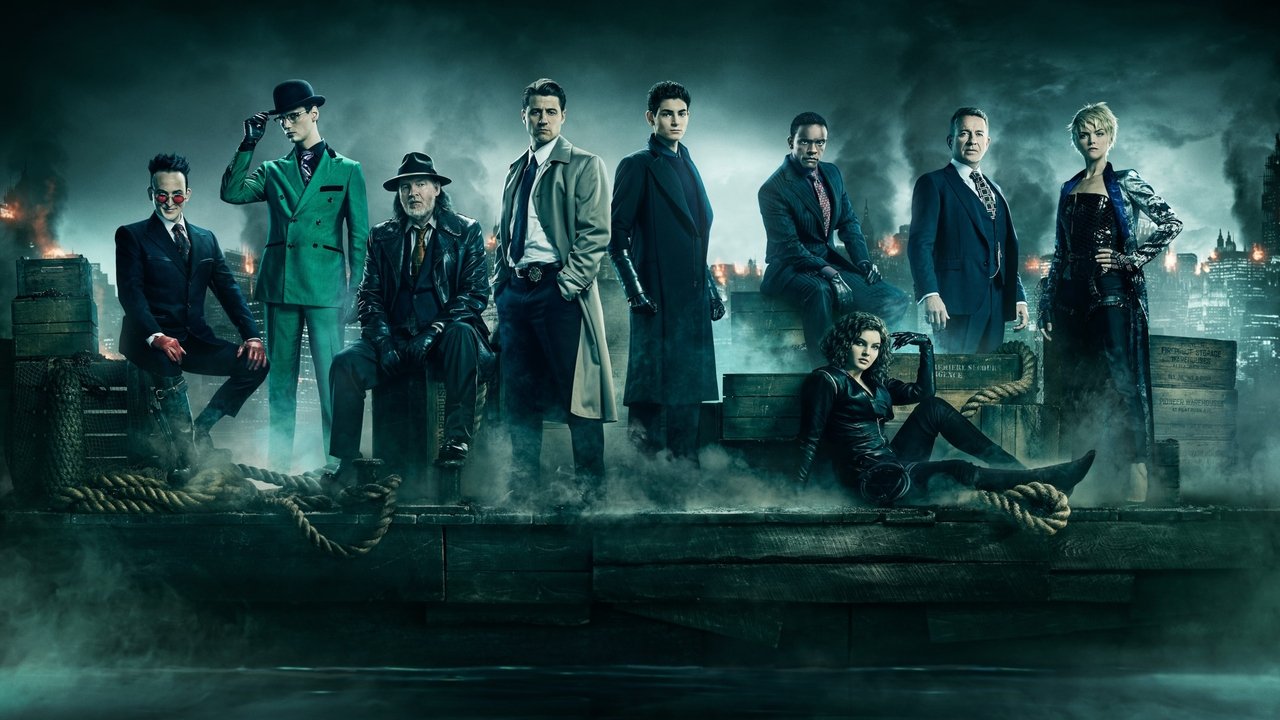

Shows Like Gotham
Everyone knows the name Commissioner Gordon. He is one of the crime world's greatest foes, a man whose reputation is synonymous with law and order. But what is known of Gordon's story and his rise from rookie detective to Police Commissioner? What did it take to navigate the multiple layers of corruption that secretly ruled Gotham City, the spawning ground of the world's most iconic villains? And what circumstances created them – the larger-than-life personas who would become Catwoman, The Penguin, The Riddler, Two-Face and The Joker?
Ranked by shared creators, cast, themes, genre, and network — not just generic recommendations.
Pennyworth: The Origin of Batman's Butler
Same creator Bruno Heller, same DC Batman-universe, same origin-story prequel format and dark crime tone.
Smallville
DC origin story following a future superhero's pre-hero years; closest structural analog to Gotham across all TV.
Arrow
DC Comics live-action, crime-fighting vigilante in a corrupt city, dark noir tone, same Arrowverse era as Gotham.
Marvel's Daredevil
Gritty crime-city superhero drama, street-level corruption and villains, dark tone; highest-rated peer in the pool.
Krypton
DC Comics origin prequel set before the main hero exists; directly mirrors Gotham's prequel-origin structural premise.
Titans
DC live-action, dark and gritty tone, Batman-universe characters (Nightwing, Robin) with mature crime storylines.
The Flash
DC Comics Arrowverse series, same 2014 launch era, superhero/supervillain origin stories, strong procedural elements.
Powers
Homicide detectives investigating superhuman crimes in a corrupt city; premise directly mirrors Gotham's police-procedural core.
Legion
Dark, psychological comic-based superhero drama with institutional settings (asylum) matching Gotham's Arkham storylines.
Watchmen
Dark graphic-novel adaptation, corrupt institutions, vigilante crime drama — shares Gotham's tone and thematic depth.
Constantine
DC Comics live-action, same 2014 era, dark supernatural crime procedural with villain-of-the-week structure.
The Mentalist
Same showrunner Bruno Heller; crime procedural with sharp character dynamics, though no superhero/DC elements.
Black Lightning
DC Comics superhero fighting gang violence and city corruption; shares Gotham's social-crime thematic layer.
Marvel's Runaways
Comic-based superhero drama with villainous adults and young protagonists; lighter tone but same origin-story structure.
Marvel's Cloak & Dagger
Comic-based, crime-city setting, young heroes discovering powers against corrupt institutions; adjacent in tone.
Peacemaker
DC universe live-action with dark comedy and villain-as-protagonist angle; shares DC lineage but very different tone.
Gen V
Dark superhero drama with institutional corruption and morally grey characters; adjacent via tone and comic-based origin.
Heroes
Ensemble superhuman origin stories with villains; broader in scope and lighter on crime-city noir but shares super-power DNA.
Helstrom
Comic-based dark drama with villain heritage and institutional settings; cousin via tone but supernatural rather than crime.
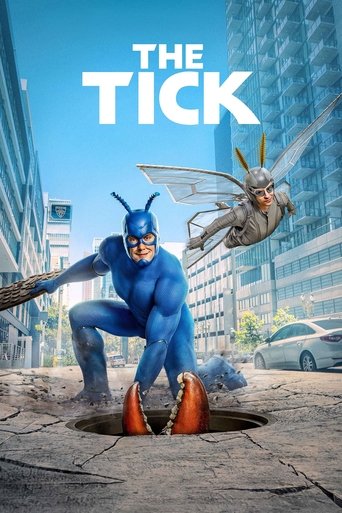
The Tick
Superhero/supervillain premise in a crime city, but parody-comedy tone is opposite to Gotham's dark noir seriousness.
How Good Is Gotham?
Ratings across IMDb and TMDB, plus our verdict.
Where to Watch Gotham
Streaming, rental, and purchase options across 40+ countries.
United States
USBuy
5 Amazon Video
 Apple TV Store
 Fandango At Home
 Amazon DVD / Blu-ray
 GRUV
GRUVAvailable in 51 countries
Frequently asked about Gotham
Common questions people search for, with answers written by us at MoviesPack.
How does Oswald Cobblepot transform into the Penguin over the course of the series?
Oswald begins as a Fish Mooney's mistreated umbrella boy, using servility and perceived weakness as a survival tool while secretly cultivating ruthless ambition. He manipulates rivals against each other, engineering Fish's downfall and gradually climbing Gotham's criminal hierarchy through betrayal and cunning rather than brute force. By the series finale he has become Mayor and one of Gotham's most powerful crime bosses, his trademark waddle and obsession with respect fully cemented as defining character traits.
What is the significance of Jerome and Jeremiah Valeska to the Joker mythology in Gotham?
The show deliberately splits the proto-Joker identity between twin brothers: Jerome is the charismatic, anarchic instigator whose cult-like influence spreads 'madness' across Gotham even after his death, while Jeremiah is the more calculating, genius-level villain who ultimately embraces full Joker iconography after being exposed to Jerome's specially engineered laughing gas. The split suggests that the Joker is less a single person than an ideology — Jeremiah absorbs Jerome's legacy and becomes the definitive monster. In the flash-forward finale Jeremiah is revealed as the disfigured, cackling nemesis who will become Bruce Wayne's eternal villain.
Why does Ra's al Ghul consider Bruce Wayne his heir, and what does the Demon's Head prophecy mean?
Ra's al Ghul has observed Bruce for years, believing an ancient prophecy marks him as the 'Demon's Head' — a warrior destined to either destroy or save Gotham. Ra's wants Bruce to inherit leadership of the League of Shadows and continue a centuries-long mission of purging corrupt cities. Bruce ultimately rejects this role but fulfills a twisted version of the prophecy by killing Ra's with the Demon's blade, an act Ra's himself manipulates Bruce into performing so he can finally die after an unnaturally long life sustained by the Lazarus Pit.
What causes Butch Gilzean to become Solomon Grundy, and is he ever restored?
After being shot in the head by Penguin and dumped in Slaughter Swamp, Butch's body reanimates due to the swamp's mysterious chemical properties, transforming him into the hulking, zombie-like Solomon Grundy with no memory of his former life. Tabitha and Barbara eventually locate him and attempt to restore his humanity; a partial cure temporarily returns his memories and personality as 'Butch,' but he is shot and killed by Penguin shortly after — dying as himself rather than as the monster, which provides his arc a tragic sense of closure.
How does the No Man's Land arc recontextualize Gotham City's role in the broader DC mythology?
In the final season, a series of cataclysmic explosions orchestrated by Jeremiah Valeska and enabled by the shadowy organization known as Nyssa al Ghul's forces physically severs Gotham from the mainland, turning it into a lawless quarantine zone — mirroring the 'No Man's Land' comic storyline. The arc functions as the crucible that forces Bruce Wayne to finally commit to becoming Batman, and transforms each major villain's territory into a proto-fiefdom that prefigures the classic Gotham rogues' gallery. The 10-year time-jump epilogue confirms that this period of chaos directly forged the city's permanent relationship with costumed crime and costumed heroism.
Recent Updates
New Trailer: Gotham