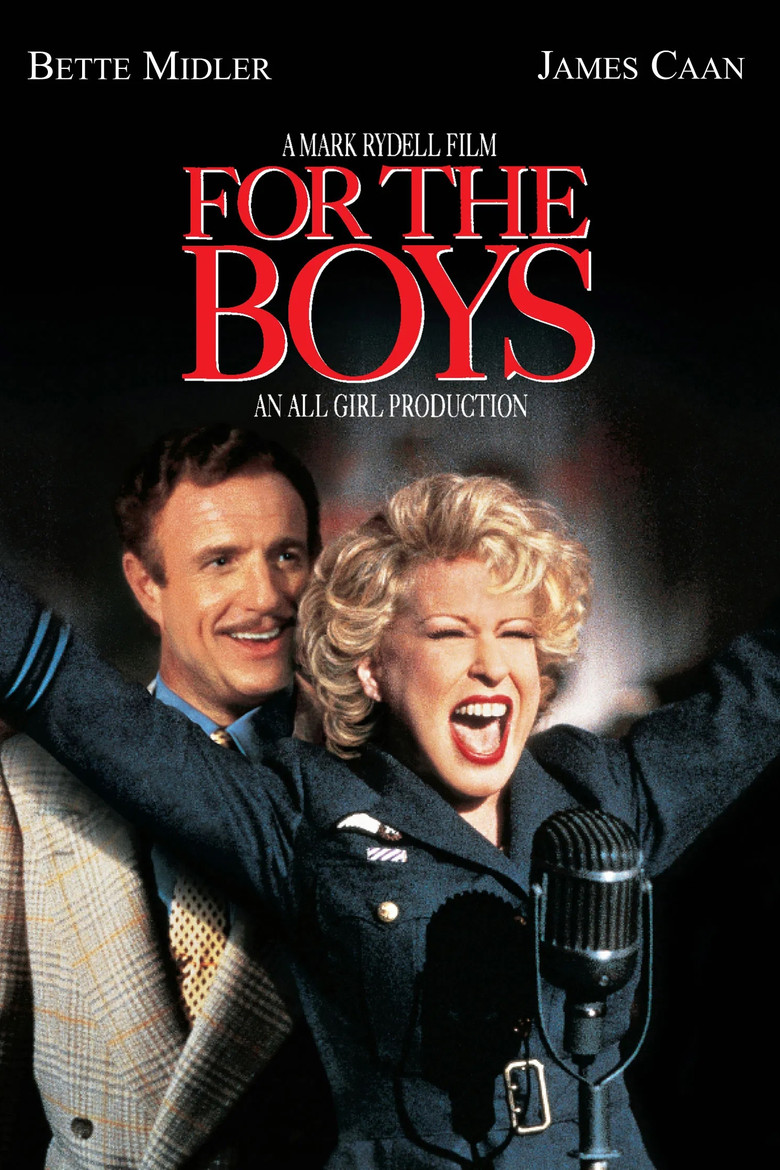
Movies Like For the Boys
Talented USO entertainer Dixie Leonard and comedian Eddie Sparks deal with their relationship over the course of 5 decades from World War II to the Vietnam War era to their twilight era in the 90's.
Ranked by shared directors, cast, themes, genre, and era — not just generic recommendations.
Good Morning, Vietnam

Almost Famous
Kolya
The Jazz Singer

School Dance
The High Note
The Secret of Santa Vittoria

Song for Marion
The Rose
One Chance
Cinderella Liberty

Coyote Ugly
Krush Groove
Taking Sides
In The Mix

Grace of My Heart

Make It Happen
Dinner in America

Dont Look Back
ATL
How Good Is For the Boys?
Ratings across IMDb, Rotten Tomatoes, Metacritic, and TMDB, plus our verdict.
Where to Watch For the Boys
Streaming, rental, and purchase options across 40+ countries.
United States
USFree with Ads
1 Hoopla
Rent
3 Amazon Video
 Apple TV Store
 Fandango At Home
Buy
4Amazon VideoApple TV StoreFandango At Home Amazon DVD / Blu-ray
Available in 14 countries
Frequently asked about For the Boys
Common questions people search for, with answers written by us at MoviesPack.
What is the movie for the boys about?
For the Boys follows USO singer Dixie Leonard (Bette Midler) and comedian Eddie Sparks (James Caan) as their on-and-off partnership and friendship spans five decades, from entertaining American troops in World War II through Korea and Vietnam into the 1990s. The film mixes musical performances with the personal and political conflicts that shape their lives across those eras.
Did James Caan sing in for the boys?
James Caan did perform vocals in For the Boys, singing and performing in several USO numbers alongside Bette Midler, including the duet "Stuff Like That There."
Is For the Boys based on a true story?
For the Boys is not based on a specific true story; it is a fictional narrative, though it draws inspiration from the real-life USO tours and from entertainers such as Martha Raye and Bob Hope who performed for American troops during World War II, Korea, and Vietnam.
Why do Eddie Sparks and Dixie Leonard stop performing together after the Korean War?
Their partnership fractures because Eddie refuses to publicly defend a blacklisted colleague during the McCarthy era, a moral cowardice Dixie cannot forgive. This political betrayal coincides with the death of Dixie's son Danny in Korea, compounding her grief with contempt for Eddie's spinelessness. The two wounds together — personal loss and Eddie's failure of integrity — make continued collaboration emotionally impossible for Dixie.
What is the purpose of the framing device where Dixie is asked to reunite with Eddie for a televised military tribute?
The film opens late in the characters' lives with Dixie being persuaded to appear alongside Eddie one final time, which turns the entire narrative into a decades-long flashback explaining why she might refuse. This structure frames the whole story as Dixie's internal reckoning: can she set aside legitimate grievances to honor something larger than her bitterness toward Eddie? The audience must understand every wound inflicted across three wars before the ending's emotional resolution carries weight.
How does the death of Dixie's son Danny echo through the film's Vietnam-era storyline?
Danny is killed in Korea, and when the film moves into the Vietnam era Dixie is now a grieving mother watching a new generation of young men die in another unpopular war. Her perspective on the troop entertainment shifts from patriotic duty to something more complicated — a form of survivor guilt mixed with genuine compassion for soldiers who remind her of Danny. This accumulation of loss is what ultimately motivates her to perform again: not forgiveness of Eddie but solidarity with the troops themselves.
Is the romantic tension between Dixie and Eddie ever resolved, or left ambiguous?
The film deliberately never consummates their relationship romantically, even though an emotional undercurrent between them persists across the entire span of their partnership. Eddie is married throughout, and Dixie's feelings are always entangled with professional resentment and moral judgment. The resolution the film offers is not romantic union but a durable emotional bond that survives betrayal and long estrangement — suggesting their connection defies simple categorization as either friendship or love.
Why does Dixie ultimately agree to appear at the final tribute despite decades of estrangement from Eddie?
Dixie's decision is framed as an act of obligation to the soldiers rather than personal reconciliation with Eddie. The film positions her choice as a separation of her private grievances from the public meaning their performances held for troops across World War II, Korea, and Vietnam. By stepping back on stage she implicitly acknowledges that withholding that gesture of solidarity would punish the wrong people, and that her partnership with Eddie — whatever its failures — belonged to something larger than either of them.
Recent Updates
For the Boys release date changed to 1991-11-22
New Trailer: For the Boys